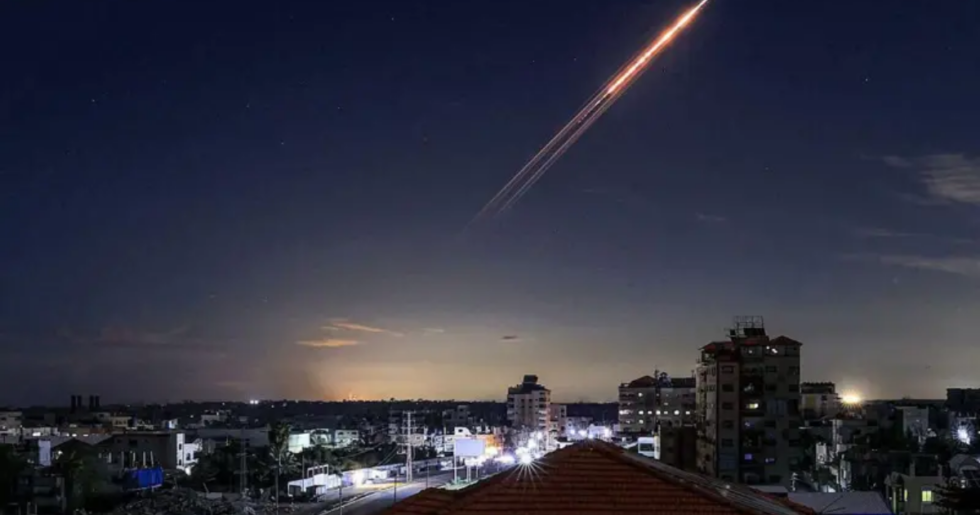
Iran has fired long-range ballistic missiles toward the joint US-UK military base located on the island of Diego Garcia in the Indian Ocean.
This action by Iran is being viewed as a sign of the escalating conflict currently unfolding in the Middle East.
Although the intended targets were not struck, the Israel Defense Forces (IDF) state that this marks the first time such long-range missiles have been deployed since the outbreak of the war.
Iran has not yet officially confirmed the missile launch, and Iranian media outlets have largely cited foreign sources in their reporting on the incident.
Experts are now assessing the implications of this failed attack, including its potential impact on the operational range of future targets.
Could European cities such as Berlin, Paris, and London also come under threat in the future?
A British Cabinet Minister has stated that there is “no concrete assessment” to corroborate the IDF’s claim that Iran possesses long-range missiles capable of reaching London.
Iran had previously imposed a self-imposed limit on the operational range of its missiles, although some observers believe that this policy has now changed.
Goncheh Habibiazad of BBC News Persian observes: “Iran’s missile program has long been a focal point of international scrutiny. While Iran consistently maintains that its missile development program is purely defensive and grounded in a strategy of national deterrence, critics argue that this expansion of long-range capabilities could fundamentally alter the regional security landscape.”
It has been less than a month since diplomatic talks were underway—with further rounds of negotiations anticipated—aimed at addressing concerns regarding Iran’s nuclear ambitions, when Israel and the United States launched an attack against Iran. The Chagos Archipelago, which includes Diego Garcia, is located approximately 3,800 kilometers away from Iran.
The *Wall Street Journal* and CNN, citing unnamed U.S. officials, reported that ballistic missiles had been fired, but stated that none of the weapons reached their intended targets.According to the reports, one missile allegedly failed during flight, while the other was intercepted and shot down by a U.S. warship. The BBC understands that these reports are accurate.Immediately following the incident, the Israel Defense Forces (IDF) stated that several cities across Europe, Asia, and Africa are now at risk. It also noted that it had warned as early as last year that Iran intended to develop missiles with such capabilities.
IDF Chief of Staff, Lieutenant General Eyal Zamir, issued a stern warning in a video message following the firing of the missiles toward the Chagos Archipelago.
He stated, “Iran has fired intercontinental ballistic missiles with a range of 4,000 kilometers. The objective of these missiles was not to target Israel; rather, their range extends to European capitals. Berlin, Paris, and Rome all fall directly within the zone of danger.”
Among other experts is General Sir Richard Barrons—former head of the UK’s Joint Forces Command and a defense specialist. He told the BBC that this incident has necessitated a fresh assessment of Iran’s missile arsenal and its reach.
He remarked, “Previously, we believed that the range of Iran’s missiles was 2,000 kilometers, whereas Diego Garcia is situated 3,800 kilometers away.”
Until now, Iran has consistently maintained that it had voluntarily imposed a self-imposed limit on its ballistic missile program, restricting their strike range to 1,240 miles (2,000 km). This meant that while Israel was within the reach of Iran’s missiles, Europe was not.Ayatollah Ali Khamenei stated in 2021 that this was a political decision—rather than one driven by any technical constraints in missile development—and that this choice was made despite opposition from military leaders and the Islamic Revolutionary Guard Corps (IRGC).
His objective was to maintain a credible threat against Israel, but not to alarm Europe, as Europe was not a target for Tehran.
However, last September, an Iranian lawmaker stated on state television that the IRGC had successfully tested an intercontinental ballistic missile, although he provided no details regarding its range.Furthermore, U.S. officials have long alleged that Iran’s space program has facilitated the development of technology that could enable it to construct intercontinental ballistic missiles.
According to *The Times of Israel*, Iran could utilize this technology should the need arise.
Some analysts concur with this assessment. Dr. Karin von Hippel, former Director General of the London-based Royal United Services Institute (RUSI), told BBC News: “If one assumes that these missiles can reach as far as Diego Garcia… then Iran is indeed developing intercontinental ballistic missiles with a potential range of up to 10,000 kilometers—missiles which, however, we have not yet observed in actual military operations.”
This would imply that missiles launched from Iran could potentially reach the U.S. mainland.
Observers now suggest that the attempted strike in the Indian Ocean signals that the geographical limits previously established by Iran have now been lifted.However, some observers remain skeptical as to whether the missiles would have successfully reached their intended targets, even had they not been intercepted beforehand.
Also Read :Are differences beginning to emerge between the US and Israel regarding the conflict with Iran?