
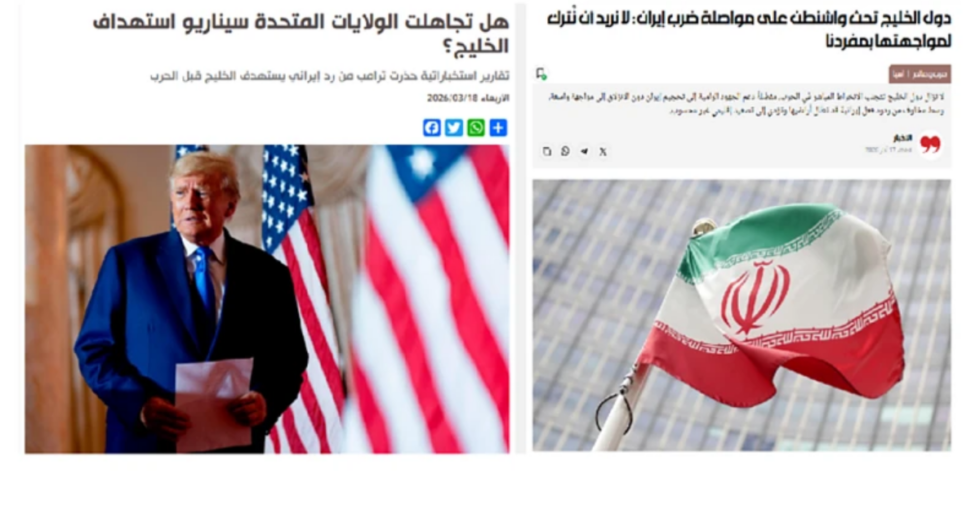
‘Gulf Nations Pressured US to Neutralize Iran’s Power’
Amidst the conflict involving Iran, discussions regarding the security situation in the Gulf region
continue unabated across both regional and domestic Arab media outlets; notably, these discussions are highlighting the differing perspectives held by the Gulf Cooperation Council (GCC) nations regarding the United States.
Some media organizations have given significant prominence to a Reuters report claiming that Gulf nations pressured the United States to “permanently neutralize Iran as the crisis in the Strait of Hormuz deepened.”
Conversely, other media outlets published reports criticizing the US decision to attack Iran, accusing Washington of “ignoring the circumstances that leave Gulf nations vulnerable to being targeted.”
Citing Gulf analysts, some reports also suggested that GCC nations would re-evaluate their long-standing security dependence on the United States. Furthermore, calls are being reiterated for the establishment of a collective defense system modeled after NATO.
Click here to join the BBC Hindi WhatsApp channel.
Meanwhile, several media outlets continued to report on the Gulf nations’ efforts to de-escalate tensions—efforts that included appeals to prioritize dialogue and diplomacy in order to avert military confrontation and resolve disputes.
The Call to ‘Destroy Iran’s Capabilities’
The Reuters report—originally published on March 16—has dominated the headlines of several Arab media outlets.
The Bethlehem-based news website *Ma’an News* ran the headline: “A Message from Gulf Nations to Trump: Do Not Stop Until Iran’s Capabilities Are Destroyed.”
*Al-Akhbar*—a Lebanese daily newspaper supportive of Hezbollah—wrote: “Gulf Nations Pressure Washington to Continue Attacks on Iran: We Do Not Want to Be Left to Face This Alone.” Citing three Gulf sources, the report stated that although Gulf nations “did not ask the U.S. to initiate a war with Iran, several countries now desire that the U.S. not stop halfway, nor leave the Islamic Republic (Iran) in a position where it could threaten Gulf oil supply routes and the economies dependent upon them.”
Abdulaziz Sager, Chairman of the Saudi Arabia-based Gulf Research Center, told Reuters, “If the Americans withdraw before completing their task, we will be left to confront Iran alone.”
The stance of certain other Arab media outlets, however, was quite different, as they criticized U.S. policy.
The London-based daily *Al-Arab* reported that U.S. intelligence agencies had warned that, in the event of an attack, Iran could target Gulf nations—a scenario, the report suggested, that the U.S. may have “overlooked.”
The report posited that this outcome was either the result of a miscalculation in assessing the Iranian response, or an indication that Washington prioritized its own political calculations over intelligence warnings.
Salem Al-Jahouri, an Omani journalist and researcher, told the Egyptian private channel *Youm7* that GCC nations would reconsider their “security dependence” on the U.S. and would also discuss the possibility of establishing a collective defense system.
He asserted that Gulf nations had been “dragged into the war” and utilized as launchpads for missiles fired from military bases situated within their territories; yet, he simultaneously emphasized that they would “in no way become directly involved in this conflict.”
Saleh Al-Mutairi, head of the Al-Madar Center for Political Studies, told Al Jazeera that GCC nations would pay a “higher price for this war” than the U.S.—particularly due to its long-term economic repercussions. Meanwhile, Omani writer and researcher Mohammed Al-Araimi told Al Jazeera that the threat is not just Iran, but also a “dangerous Israeli project” for the region.


Dhurandhar 2: Shock for South Indian Audiences; 'Dhurandhar 2' Paid Previews Cancelled—Here Is the Major Reason - THE GLAMORHOLIC